Maryse Beaupied Cortes
Osteopath & Etiopath
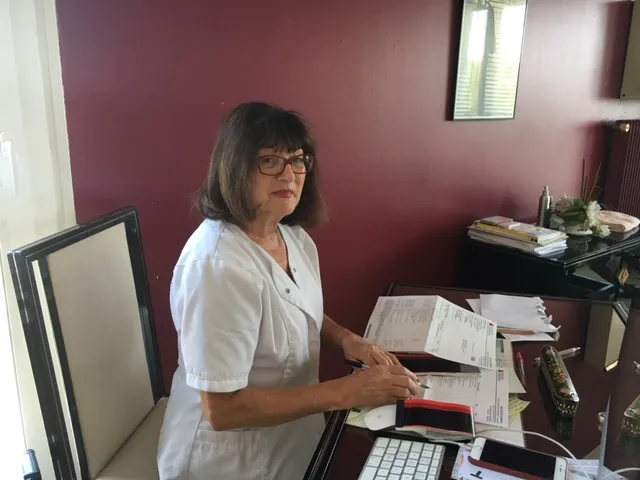
An experienced practitioner, Maryse Beaupied founded her private practice in Montbeliard in 1987.
She combines several techniques according to her patients' needs: structural (vertebral, peripheral, visceral) and facial, cranial.
What does an osteopath treat? Reasons for consulting an osteopath
Through a holistic approach, the osteopath can help alleviate disorders and symptoms affecting the following systems:
Musculoskeletal System
Stiffness, discomfort, acute or chronic pain affecting the lumbar, dorsal or cervical regions of the spine, or affecting a shoulder, ankle or knee are the osteopath's daily work.
Nervous System
Certain disorders and symptoms affecting the nervous system may benefit from osteopathy: headaches, vertigo, sciatica, crural pain, cervico-brachial neuralgia, Arnold's neuralgia, etc.
Certain conditions can also be treated by an osteopath for the patient's benefit: sleep disorders, fatigue, attention disorders, hyperactivity, anxiety, stress, depression, etc.
Digestive System
Digestive disorders, both in infants (colic or regurgitation) and adults (constipation, diarrhea, bloating, gastro-oesophageal reflux, nausea, difficulty digesting, irritable bowel syndrome, etc.)
Genitourinary System
Chronic urinary infections, certain forms of incontinence, or certain sexual disorders such as dyspareunia can be treated with osteopathy. In women, gynaecological symptoms such as irregular or painful periods can be managed. Certain forms of difficulty conceiving a child can also be supported by the osteopath.
Pregnant women can also be followed to alleviate symptoms related to pregnancy or prepare for childbirth.
Ear, Nose and Throat (ENT) System
Whether in children or adults, recurring otitis, rhinitis or sinusitis, cough, and lacrimal canal disorders can be treated with osteopathy.
Vascular System
Headaches or migraines, circulatory disorders such as poor venous return, haemorrhoids, lower limb oedema or restless legs syndrome can be alleviated through osteopathic care.
How to become an osteopath-etiopath: a bit of history
Since childhood, Maryse has had a keen taste for classical dance and contemporary dance.
Immersed in the ballets and opera repertoire that her parents listened to as true music lovers, Maryse acquired a solid musical and artistic culture.
As a young adult, Maryse began classical and contemporary dance while completing her accounting studies. She worked as an accountant in Montbeliard until the birth of her first son, Renaud.
She decided to stop working to devote herself to raising her son, then her second, Geoffroy.
Maryse Beaupied continued to practice dance passionately and became interested, through the advice of her various dance teachers, in anatomophysiological questions. Indeed, Maryse noticed that dance practice improved once the osteoarticular and visceral attachments were released — she first observed this through long stretching, warm-up and stretching exercises.
Following intense vertebral pain during a holiday in Brittany, Maryse consulted an etiopath. After osteopathic treatment, Maryse regained full mobility and very quickly enrolled at the European Centre for Osteopathy and Etiopathy in Geneva: a new career opened up for her.
Thus she balanced her role as a mother while embarking on 5 years of intensive study in Switzerland, culminating in a diploma obtained in 1987.
She founded her private osteopathy-etiopathy practice in 1987, a haven of peace and good practice.
Maryse Beaupied and CALYP
"Adeline Toniutti came to consult me several years ago following a car accident. She was then in the midst of her singing career and had suffered a serious cervical trauma that hindered her professional practice of singing.
It is true that Adeline was immediately charmed when I asked her to lie on the table while the music of La Traviata played through the walls of my practice in Montbeliard.
The bond was strong from the start between us, our minds in harmony regarding both the biomechanical and energetic approach to the body, and the relationship between the operatic voice and the singer.
Very quickly we met again to work together on the possible contributions and positive interactions between high-level singing practice and the properties of osteopathy and etiopathy.
Gradually, I realised my dream: learning to sing opera with Adeline.
Maryse Beaupied is a founding member of CALYP
As we collaborated to interweave our knowledge, Adeline and I, together with Ruta Lenciauskaite (pianist and vocal coach at the Paris Opera), Jean Charmoille (psychiatrist and psychoanalyst in Paris and Montbeliard) and my colleague Pierre-Yves Predour (osteopath in Paris), came up with the idea of creating CALYP — Centre d'Art Lyrique de Paris. CALYP is a training and exchange space where practitioners, scientists, specialists, artists, journalists, artistic agents and teachers exchange and collaborate on various missions determined before the association was created, among which I would like to mention:
The development of lyrical art, the creation of a case-by-case protocol for singer training, the care of pre- and post-operative laryngeal surgery patients, and the contribution of operatic singing in the treatment of autism.
As an osteopath and opera enthusiast, I find the unprecedented multidisciplinary approach created by CALYP both formidable and enriching, for singers and practitioners alike.
I believe that our regular exchanges and enthusiasm will considerably energise the various professions and specialities present at CALYP.
It is for these reasons that I accepted the position of General Secretary and founding honorary member of this association."
Osteopathy-Etiopathy Practice
20 rue du petit Chenois
25200 Montbeliard
Tel 1: 03 81 90 25 41
Tel 2: 06 81 00 36 24
Email: beaupied.m@wanadoo.fr